 Add to Chrome
 Add to Firefox
 Add to Edge
Escape the Language Prior: Mitigating Late-Stage Modality Collapse in Audio Reasoning via Modality-Aware Policy Optimization
May 26, 2026
Audio and omni-modal large language models exhibit impressive cross-modal reasoning capabilities. However, applying standard reinforcement learning post-training algorithms to these models exposes a critical structural vulnerability: methods like GRPO apply uniform policy gradients across all tokens, ignoring their unequal dependence on the non-text source modality. This exacerbates late-stage modality collapse during extended chain-of-thought generation, where models progressively abandon the primary source signal in favor of compressed textual priors, leading to confident but ungrounded hallucinations. To address this, we introduce Modality-Aware Policy Optimization (MAPO), a novel dual-branch reinforcement learning framework. First, MAPO dynamically concentrates the policy gradient on modality-critical tokens using a modality relevance mask, which is derived from the cross-modal differential entropy between an audio-ablated reference and the multimodal policy. Second, it integrates an auxiliary attention loss branch that applies a targeted, temporally scaled penalty to the model's internal attention distributions. This ensures the model actively sustains cross-modal grounding deep into the reasoning trace. Evaluations on complex audio reasoning benchmarks demonstrate that MAPO substantially improves long-horizon reasoning fidelity and multimodal instruction following, achieving highly competitive performance and setting new state-of-the-art results on several key benchmarks among open-weight models. By relying strictly on native statistical signals rather than domain-specific inductive biases, MAPO offers a promising foundation for mitigating epistemic collapse across diverse multimodal systems.

Audio-DeepThinker: Progressive Reasoning-Aware Reinforcement Learning for High-Quality Chain-of-Thought Emergence in Audio Language Models
Apr 20, 2026Large Audio-Language Models (LALMs) have made significant progress in audio understanding, yet they primarily operate as perception-and-answer systems without explicit reasoning processes. Existing methods for enhancing audio reasoning rely either on supervised chain-of-thought (CoT) fine-tuning, which is limited by training data quality, or on reinforcement learning (RL) with coarse rewards that do not directly evaluate reasoning quality. As a result, the generated reasoning chains often appear well-structured yet lack specific acoustic grounding. We propose Audio-DeepThinker, a framework built on two core ideas. First, we introduce a hybrid reasoning similarity reward that directly supervises the quality of generated reasoning chains by combining an LLM evaluator assessing logical path alignment, key step coverage, and analytical depth with an embedding similarity component enforcing semantic alignment with reference reasoning chains. Second, we propose a progressive two-stage curriculum that enables high-quality CoT reasoning to emerge through pure RL exploration, without any supervised reasoning fine-tuning, from an instruction-tuned model that possesses no prior chain-of-thought capability. Stage 1 trains on foundational audio QA with the hybrid reward to foster basic reasoning patterns, while Stage 2 shifts to acoustically challenging boundary cases with an LLM-only reward for greater reasoning diversity. Audio-DeepThinker achieves state-of-the-art results on MMAR (74.0%), MMAU-test-mini (78.5%), and MMSU (77.26%), winning 1st Place in the Interspeech 2026 Audio Reasoning Challenge (Single Model Track). Interpretability analyses further reveal that RL training primarily reshapes upper-layer MoE gating mechanisms and that reasoning tokens crystallize progressively in the upper transformer layers, offering mechanistic insights into how audio reasoning emerges through exploration.
Object-Attribute-Relation Model Driven Adaptive Hierarchical Transmission for Multimodal Semantic Communication
Apr 09, 2026Traditional video coding (VVC, HEVC) prioritizes human visual perception, transmitting substantial texture redundancy that severely hinders machine decision-making under constrained bandwidths. In dynamic channels, this redundancy causes severe ``cliff effects'' and prohibitive latency. To address this, we propose a robust multimodal semantic communication framework based on an adaptive Object-Attribute-Relation (O-A-R) hierarchy. Bypassing pixel-level reconstruction entirely, our framework directly fuses visual, textual, and audio streams to construct a decision-oriented topological graph. A bandwidth-adaptive strategy dynamically allocates resources by semantic priority, while a cross-modal mechanism leverages text and audio priors to compensate for severe visual degradation. Experimental results demonstrate that under extreme low bandwidths (1-3 kbps), our method achieves over a 90% bandwidth saving (an approximately 10-fold reduction) compared to state-of-the-art digital schemes, maintaining superior scene-graph accuracy. In deep fading channels (SNR <= 4 dB), it completely eliminates the cliff effect, ensuring graceful degradation by strictly preserving foundational object anchors even when traditional codecs suffer 100% decoding failure. Coupled with an 89\% reduction in end-to-end latency, our framework comprehensively fulfills the real-time survival requirements of embodied agents.
Covo-Audio Technical Report
Feb 10, 2026In this work, we present Covo-Audio, a 7B-parameter end-to-end LALM that directly processes continuous audio inputs and generates audio outputs within a single unified architecture. Through large-scale curated pretraining and targeted post-training, Covo-Audio achieves state-of-the-art or competitive performance among models of comparable scale across a broad spectrum of tasks, including speech-text modeling, spoken dialogue, speech understanding, audio understanding, and full-duplex voice interaction. Extensive evaluations demonstrate that the pretrained foundation model exhibits strong speech-text comprehension and semantic reasoning capabilities on multiple benchmarks, outperforming representative open-source models of comparable scale. Furthermore, Covo-Audio-Chat, the dialogue-oriented variant, demonstrates strong spoken conversational abilities, including understanding, contextual reasoning, instruction following, and generating contextually appropriate and empathetic responses, validating its applicability to real-world conversational assistant scenarios. Covo-Audio-Chat-FD, the evolved full-duplex model, achieves substantially superior performance on both spoken dialogue capabilities and full-duplex interaction behaviors, demonstrating its competence in practical robustness. To mitigate the high cost of deploying end-to-end LALMs for natural conversational systems, we propose an intelligence-speaker decoupling strategy that separates dialogue intelligence from voice rendering, enabling flexible voice customization with minimal text-to-speech (TTS) data while preserving dialogue performance. Overall, our results highlight the strong potential of 7B-scale models to integrate sophisticated audio intelligence with high-level semantic reasoning, and suggest a scalable path toward more capable and versatile LALMs.
PhyAVBench: A Challenging Audio Physics-Sensitivity Benchmark for Physically Grounded Text-to-Audio-Video Generation
Dec 30, 2025Text-to-audio-video (T2AV) generation underpins a wide range of applications demanding realistic audio-visual content, including virtual reality, world modeling, gaming, and filmmaking. However, existing T2AV models remain incapable of generating physically plausible sounds, primarily due to their limited understanding of physical principles. To situate current research progress, we present PhyAVBench, a challenging audio physics-sensitivity benchmark designed to systematically evaluate the audio physics grounding capabilities of existing T2AV models. PhyAVBench comprises 1,000 groups of paired text prompts with controlled physical variables that implicitly induce sound variations, enabling a fine-grained assessment of models' sensitivity to changes in underlying acoustic conditions. We term this evaluation paradigm the Audio-Physics Sensitivity Test (APST). Unlike prior benchmarks that primarily focus on audio-video synchronization, PhyAVBench explicitly evaluates models' understanding of the physical mechanisms underlying sound generation, covering 6 major audio physics dimensions, 4 daily scenarios (music, sound effects, speech, and their mix), and 50 fine-grained test points, ranging from fundamental aspects such as sound diffraction to more complex phenomena, e.g., Helmholtz resonance. Each test point consists of multiple groups of paired prompts, where each prompt is grounded by at least 20 newly recorded or collected real-world videos, thereby minimizing the risk of data leakage during model pre-training. Both prompts and videos are iteratively refined through rigorous human-involved error correction and quality control to ensure high quality. We argue that only models with a genuine grasp of audio-related physical principles can generate physically consistent audio-visual content. We hope PhyAVBench will stimulate future progress in this critical yet largely unexplored domain.
Audio-Thinker: Guiding Audio Language Model When and How to Think via Reinforcement Learning
Aug 12, 2025Recent advancements in large language models, multimodal large language models, and large audio language models (LALMs) have significantly improved their reasoning capabilities through reinforcement learning with rule-based rewards. However, the explicit reasoning process has yet to show significant benefits for audio question answering, and effectively leveraging deep reasoning remains an open challenge, with LALMs still falling short of human-level auditory-language reasoning. To address these limitations, we propose Audio-Thinker, a reinforcement learning framework designed to enhance the reasoning capabilities of LALMs, with a focus on improving adaptability, consistency, and effectiveness. Our approach introduces an adaptive think accuracy reward, enabling the model to adjust its reasoning strategies based on task complexity dynamically. Furthermore, we incorporate an external reward model to evaluate the overall consistency and quality of the reasoning process, complemented by think-based rewards that help the model distinguish between valid and flawed reasoning paths during training. Experimental results demonstrate that our Audio-Thinker model outperforms existing reasoning-oriented LALMs across various benchmark tasks, exhibiting superior reasoning and generalization capabilities.
Mitigating Audiovisual Mismatch in Visual-Guide Audio Captioning
May 28, 2025Current vision-guided audio captioning systems frequently fail to address audiovisual misalignment in real-world scenarios, such as dubbed content or off-screen sounds. To bridge this critical gap, we present an entropy-aware gated fusion framework that dynamically modulates visual information flow through cross-modal uncertainty quantification. Our novel approach employs attention entropy analysis in cross-attention layers to automatically identify and suppress misleading visual cues during modal fusion. Complementing this architecture, we develop a batch-wise audiovisual shuffling technique that generates synthetic mismatched training pairs, greatly enhancing model resilience against alignment noise. Evaluations on the AudioCaps benchmark demonstrate our system's superior performance over existing baselines, especially in mismatched modality scenarios. Furthermore, our solution demonstrates an approximately 6x improvement in inference speed compared to the baseline.
Information-Theoretic Complementary Prompts for Improved Continual Text Classification
May 27, 2025Continual Text Classification (CTC) aims to continuously classify new text data over time while minimizing catastrophic forgetting of previously acquired knowledge. However, existing methods often focus on task-specific knowledge, overlooking the importance of shared, task-agnostic knowledge. Inspired by the complementary learning systems theory, which posits that humans learn continually through the interaction of two systems -- the hippocampus, responsible for forming distinct representations of specific experiences, and the neocortex, which extracts more general and transferable representations from past experiences -- we introduce Information-Theoretic Complementary Prompts (InfoComp), a novel approach for CTC. InfoComp explicitly learns two distinct prompt spaces: P(rivate)-Prompt and S(hared)-Prompt. These respectively encode task-specific and task-invariant knowledge, enabling models to sequentially learn classification tasks without relying on data replay. To promote more informative prompt learning, InfoComp uses an information-theoretic framework that maximizes mutual information between different parameters (or encoded representations). Within this framework, we design two novel loss functions: (1) to strengthen the accumulation of task-specific knowledge in P-Prompt, effectively mitigating catastrophic forgetting, and (2) to enhance the retention of task-invariant knowledge in S-Prompt, improving forward knowledge transfer. Extensive experiments on diverse CTC benchmarks show that our approach outperforms previous state-of-the-art methods.
Hearing from Silence: Reasoning Audio Descriptions from Silent Videos via Vision-Language Model
May 19, 2025Humans can intuitively infer sounds from silent videos, but whether multimodal large language models can perform modal-mismatch reasoning without accessing target modalities remains relatively unexplored. Current text-assisted-video-to-audio (VT2A) methods excel in video foley tasks but struggle to acquire audio descriptions during inference. We introduce the task of Reasoning Audio Descriptions from Silent Videos (SVAD) to address this challenge and investigate vision-language models' (VLMs) capabilities on this task. To further enhance the VLMs' reasoning capacity for the SVAD task, we construct a CoT-AudioCaps dataset and propose a Chain-of-Thought-based supervised fine-tuning strategy. Experiments on SVAD and subsequent VT2A tasks demonstrate our method's effectiveness in two key aspects: significantly improving VLMs' modal-mismatch reasoning for SVAD and effectively addressing the challenge of acquiring audio descriptions during VT2A inference.
Exploring Modality Disruption in Multimodal Fake News Detection
Apr 12, 2025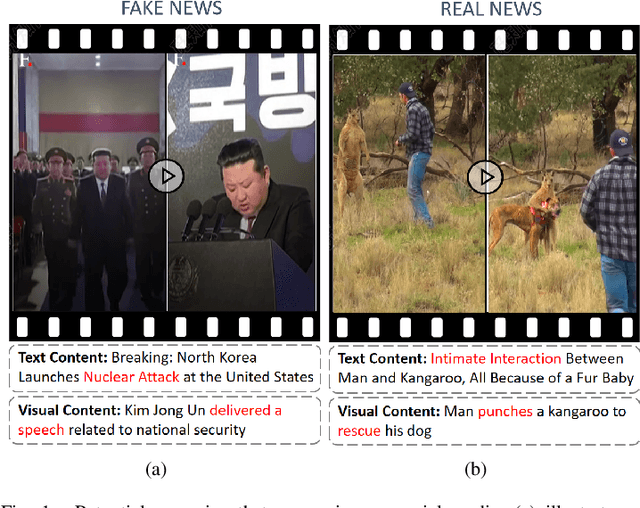
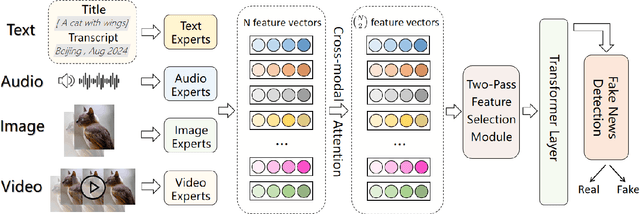
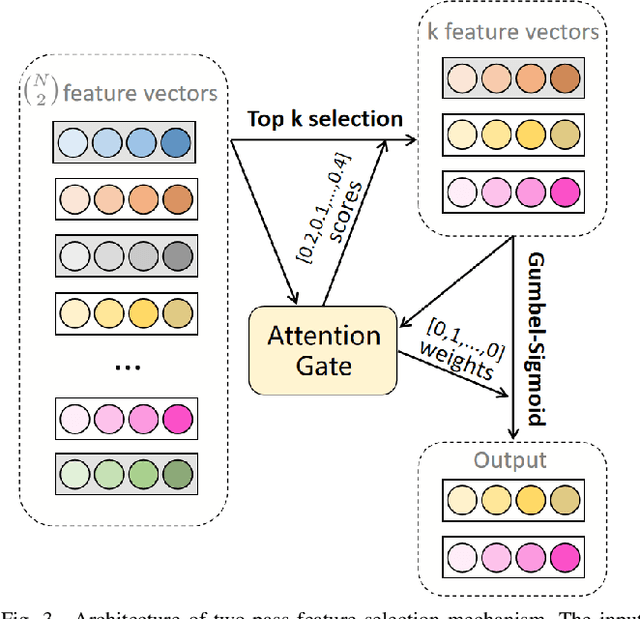
The rapid growth of social media has led to the widespread dissemination of fake news across multiple content forms, including text, images, audio, and video. Compared to unimodal fake news detection, multimodal fake news detection benefits from the increased availability of information across multiple modalities. However, in the context of social media, certain modalities in multimodal fake news detection tasks may contain disruptive or over-expressive information. These elements often include exaggerated or embellished content. We define this phenomenon as modality disruption and explore its impact on detection models through experiments. To address the issue of modality disruption in a targeted manner, we propose a multimodal fake news detection framework, FND-MoE. Additionally, we design a two-pass feature selection mechanism to further mitigate the impact of modality disruption. Extensive experiments on the FakeSV and FVC-2018 datasets demonstrate that FND-MoE significantly outperforms state-of-the-art methods, with accuracy improvements of 3.45% and 3.71% on the respective datasets compared to baseline models.